Disclaimer: The results provided by this calculator are for informational and educational purposes only and should not be considered professional advice.
Accuracy is not guaranteed, and you should consult a qualified professional for decisions related to finance, health, legal matters, or medical treatment.
By using this tool, you acknowledge that CalcZen.com is not responsible for any actions taken based on its results.
Cracking the Code: What is 14 out of 20 as a Percentage?
C
CalcZen.com
Updated: Jul 14, 2026
Ever found yourself staring at a quiz paper, a fitness tracker, or a store discount, trying to figure out if you're "winning" or just "getting by"? We’ve all been there. Maybe you just got a score of 14 on a 20-point test, or perhaps you're tracking your progress toward a goal. Understanding 14 out of 20 as a percentage isn't just a classroom exercise—it's a vital life skill that helps you visualize success.
In this guide, I’m going to show you exactly how to convert that fraction into a percentage so you never have to guess again. No math anxiety required—just a few simple steps and a clean way to get the job done.
Fraction to Percentage Calculator
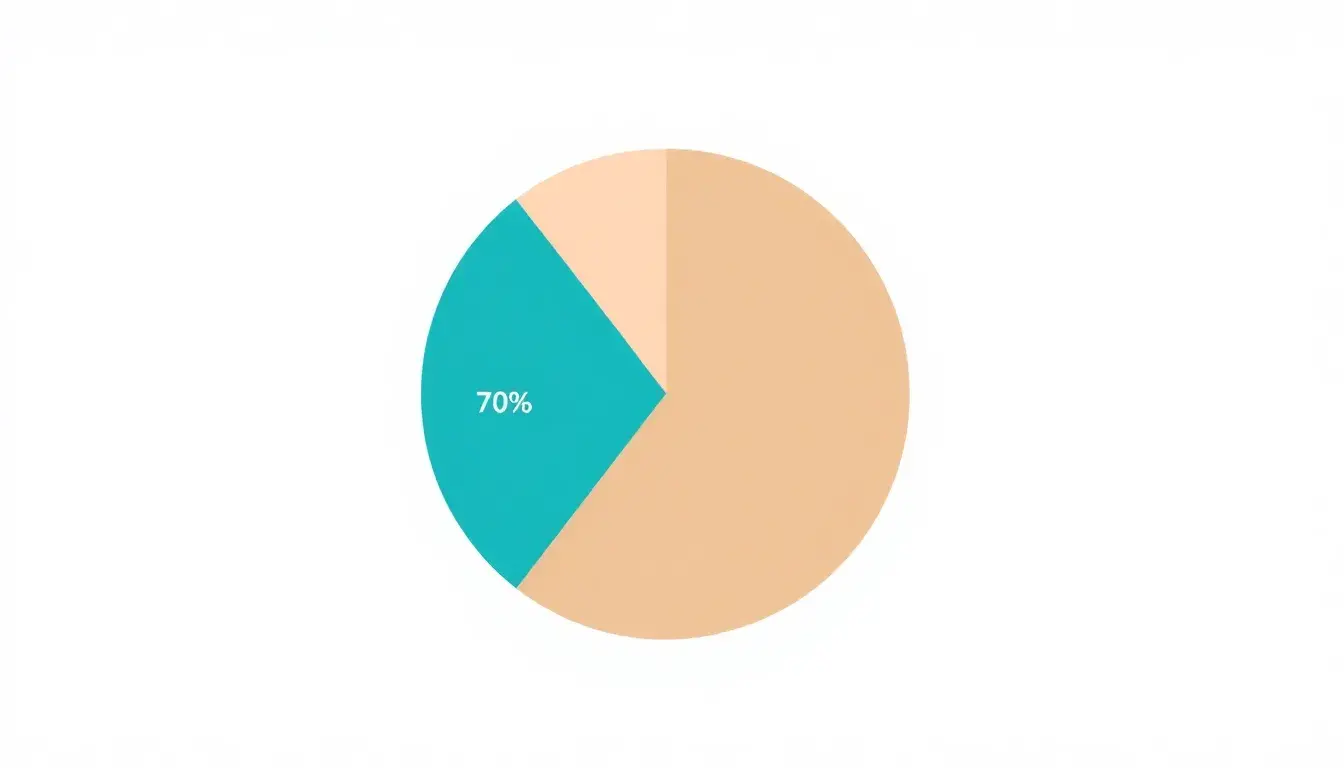
Result: 70%
The Quick Answer: 14/20 is 70%
If you're in a hurry, here is the bottom line: 14 out of 20 as a percentage is 70%. In the world of academic grading, this usually translates to a solid 'C' or a 'B-' depending on your school's curve. But how did we get there? It’s simpler than it looks, and once you see the pattern, you’ll be doing these in your head while you wait for your coffee to brew.
Pro Tip: To convert any fraction to a percentage, just divide the top number (numerator) by the bottom number (denominator) and multiply by 100. Example: (14 ÷ 20) × 100 = 70%
Step-by-Step: How to Calculate 14 out of 20
Math shouldn't feel like a secret society. There are actually three very easy ways to arrive at 70%. Choose the one that feels most natural to you!
1. The Division Method (The Universal Way)
This works for any fraction, no matter how "ugly" the numbers are. You take your 14 and divide it by 20. On a calculator (or in your head), 14 divided by 20 equals 0.70. To turn any decimal into a percentage, you just move the decimal point two places to the right. Voila: 70%.
2. The "Scale to 100" Method (The Mental Math Shortcut)
Percentages are always based on the number 100. Since 20 goes into 100 exactly five times ($20 \times 5 = 100$), you can just multiply both parts of your fraction by 5.
$14 \times 5 = 70$
$20 \times 5 = 100$
Now you have 70/100, which is the literal definition of 70 percent. This is my favorite trick for quick "sanity checks" when I'm out and about.
3. The Simplification Method
Sometimes, shrinking the numbers makes the answer obvious. If you divide both 14 and 20 by 2, you get 7/10. Anyone who has ever handled a dime knows that 7 out of 10 is 70%. It’s amazing how much friendlier numbers become when you break them down to their simplest form.
Why Does This Calculation Matter?
You might be wondering, "When will I actually use this?" Beyond passing a math quiz, understanding percentages like 14 out of 20 helps you in dozens of real-world scenarios:
Budgeting: If you've spent $14 of a $20 daily allowance, you know you've already burned through 70% of your cash. Time to skip the extra snack!
Fitness Goals: If you set out to do 20 pushups and hit 14, you're 70% of the way to your goal. That's a huge win—keep going!
Sales & Discounts: Seeing a "Save $6 when you spend $20" sign? That's a 30% discount, leaving you paying 70% of the original price.
Project Management: If a 20-day project is on day 14, you should be roughly 70% finished with your milestones.
Stop guessing and start calculating. Whether you're a student, a professional, or just someone who wants to get their budget right, Calczen.com offers a suite of ad-light, lightning-fast tools designed for your daily life.
Even the pros slip up sometimes. Here are a few things to watch out for when calculating 14 out of 20 as a percentage:
The "Upside Down" Error: Make sure you aren't dividing 20 by 14. That would give you roughly 142%, which definitely isn't the grade you're looking for! Always put the "part" (14) over the "whole" (20).
Decimal Drift: When converting 0.7 to a percentage, remember it’s 70%, not 7%. If you have 0.7 of a pie, you have almost the whole thing, not just a tiny sliver.
Final Thoughts: Calculate Smarter, Not Harder
Finding 14 out of 20 as a percentage is a gateway to feeling more confident with numbers. Once you realize that math is just a tool to help you measure your life, it stops being a chore and starts being a superpower. At Calczen.com, we believe that everyone deserves access to clean, reliable tools that make these calculations instant and stress-free.
Next time you're faced with a fraction, don't let it ruffle your feathers. Use the methods we discussed or just head back here to our Fraction to Percentage Calculator. We’ve got your back!