New Feature: Calculator results are now clearer and easier to use ⚡

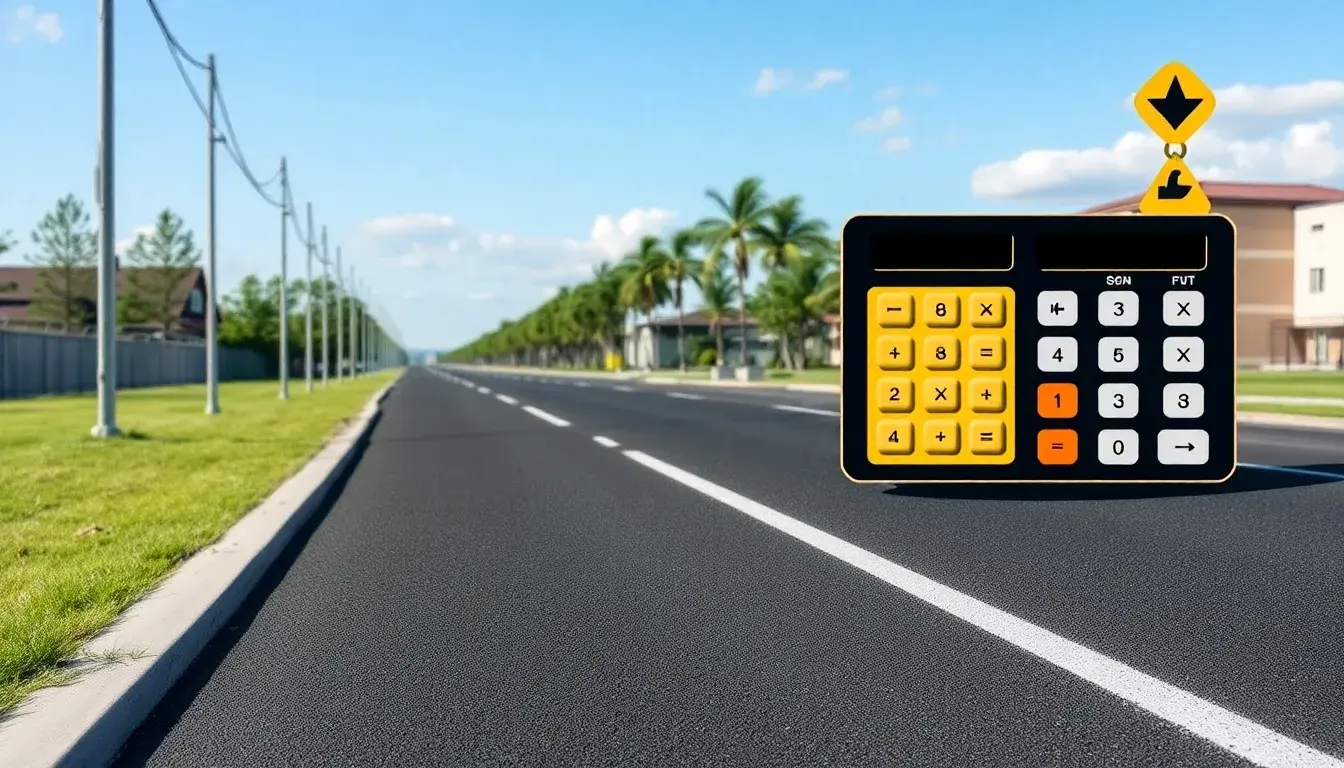
Asphalt Calculator

52 Uses
6 min read
Verified Accuracy

Disclaimer: The results provided by this calculator are for informational and educational purposes only and should not be considered professional advice. Accuracy is not guaranteed, and you should consult a qualified professional for decisions related to finance, health, legal matters, or medical treatment. By using this tool, you acknowledge that CalcZen.com is not responsible for any actions taken based on its results.

calczen-widget
⚡ Powered by CalcZen • Secure & Private • Real-time Results

How to Use an Asphalt Calculator to Nail Your Next Paving Project

C

CalcZen.com

Updated: May 29, 2026

asphalt calculator

We’ve all been there—staring at a cracked, graying driveway and wondering exactly how much it’s going to cost to fix it. Paving is one of those big-ticket home improvements that feels intimidating because the math seems complicated. How deep should the blacktop be? How many tons of hot mix do I actually need? If you order too little, you’re stuck with a half-finished mess; order too much, and you’re literally throwing money onto the curb.

That’s where a reliable asphalt calculator comes in. In this guide, I’m going to walk you through how to estimate your materials like a pro, so you can walk into a meeting with a contractor—or your local supply yard—feeling confident. At Calczen.com, we believe math shouldn't be a barrier to a beautiful home. Let’s break down the numbers together.

Why Accuracy Matters in Construction Estimating

I remember my first "small" paving project. I thought I could eye-ball it. "It’s just a rectangle," I told myself. Fast forward four hours, and I was staring at a three-inch gap at the edge of the walkway because I hadn't accounted for the density of the mix. It was a classic rookie mistake that cost me an extra delivery fee and a lot of pride.

When you're dealing with raw materials, precision is your best friend. Asphalt isn't just sold by the bag like mulch; it’s sold by weight, usually in tons. Because the density of asphalt is roughly 145 pounds per cubic foot, even a slight miscalculation in the thickness of your layer can swing your total tonnage by a massive margin.

Pro Tip: Always add a 5-10% "waste factor" to your final estimate. Between spills, uneven sub-bases, and compacting, you'll almost always use slightly more than the theoretical perfect number.

Breaking Down the Dimensions: Area and Thickness

The core of any asphalt calculator logic relies on three numbers: length, width, and depth (thickness). While length and width are straightforward, the thickness is where most people get tripped up.

Measuring the Area

For standard rectangular driveways, it's easy: Length × Width. But let's be real—most driveways have curves, flared entries, or parking pads. To get an accurate reading, I recommend breaking your driveway into smaller geometric shapes. Measure each rectangle or triangle separately, calculate their areas, and add them up. It takes ten extra minutes but saves hundreds of dollars.

Choosing Your Thickness

How thick should your asphalt be? It depends on what you're doing:

  • Resurfacing/Overlay: Usually 1.5 to 2 inches. This is when you're laying new blacktop over a solid existing base.
  • New Driveway: Typically 3 to 4 inches of hot mix asphalt, usually laid in two separate lifts (layers) for better compaction.
  • Heavy Duty: If you're parking an RV or a heavy work truck, you might want to look at 5-6 inches.

Using a tool like the one in our Construction & DIY Estimators category helps you toggle these depths instantly to see how it impacts your budget.

The "Tonnage" Secret: From Volume to Weight

This is the part that usually confuses people. You’ve calculated that you need 200 cubic feet of material. Great. But the paving company asks, "How many tons?"

Since we know the density (approx. 145 lbs/cu ft), the math goes like this: (Total Cubic Feet × 145) / 2,000. It's a bit of a headache to do on a napkin while the contractor is waiting for an answer. This is exactly why I'm such a fan of digital tools—they handle the density conversion in the background, so you can focus on the logistics of the project.

Want to dive deeper into the science of paving materials? You can check out the technical details on material science to understand why compaction rates vary, but for most of us, a standard estimator is all we need to get the job done right.

Common Pitfalls to Avoid

Even with the best tools, human error happens. Here are a few things I’ve learned the hard way:

1. Forgetting the Sub-Base

Asphalt is only as good as the ground beneath it. If you’re digging out a new area, you’ll also need to calculate "crushed stone" or "GAB" (Graded Aggregate Base). This usually needs to be thicker than the asphalt itself (often 6-8 inches).

2. Measuring in Inches vs. Feet

Most people measure length in feet but thickness in inches. If you multiply 50ft (length) × 10ft (width) × 2 (thickness), you'll get 1,000. But that's not 1,000 cubic feet! You have to convert that 2 inches into 0.166 feet. (Again, this is why using a dedicated calculator is a lifesaver—it handles the unit conversions for you).

3. Ignoring Slope

If your driveway has a significant incline, the surface area is actually slightly larger than the flat "plan" view. For most residential jobs, the difference is negligible, but for steep hills, it can add up to a few extra tons of material.

Calculate Your Project in Seconds

Don't leave your budget to guesswork. Head over to Calczen.com to use our free Asphalt Calculator and dozens of other DIY tools designed to make your project stress-free.

Explore Construction Calculators

Why I Trust Calczen.com for My DIY Projects

I’ve tested a lot of "free" sites over the years. Usually, you’re halfway through a calculation when a massive pop-up ad blocks the "equals" button, or the site is so laggy it feels like you're using a computer from 1995. It’s frustrating when you’re just trying to get work done.

We built Calczen to be the antidote to that. We focus on clean, fast, and mobile-friendly tools. Whether you're standing in the middle of your driveway with a tape measure or sitting at your desk planning a multi-phase renovation, you deserve results that are instant and accurate. No fluff, just math that works.

Using an asphalt calculator shouldn't be the hardest part of your Saturday. By taking the time to measure twice and calculate once, you're setting yourself up for a paving job that looks professional and lasts for decades. Go ahead—grab that tape measure, plug in the numbers, and take control of your home improvement journey!
Share this Tool

Discussion (0)

Moderated
Security Check: 10 + 7 =

No comments yet. Start the conversation!

Related Tools & Calculators

Master Your Data.

Get weekly updates on new financial regulations, mathematical formulas, and CalcZen tools.

Join 25,000+ data-driven professionals. No spam, ever.

CALCZEN