0
Total Square Feet
Disclaimer: The results provided by this calculator are for informational and educational purposes only and should not be considered professional advice. Accuracy is not guaranteed, and you should consult a qualified professional for decisions related to finance, health, legal matters, or medical treatment. By using this tool, you acknowledge that CalcZen.com is not responsible for any actions taken based on its results.
CalcZen.com
Updated: Jul 13, 2026
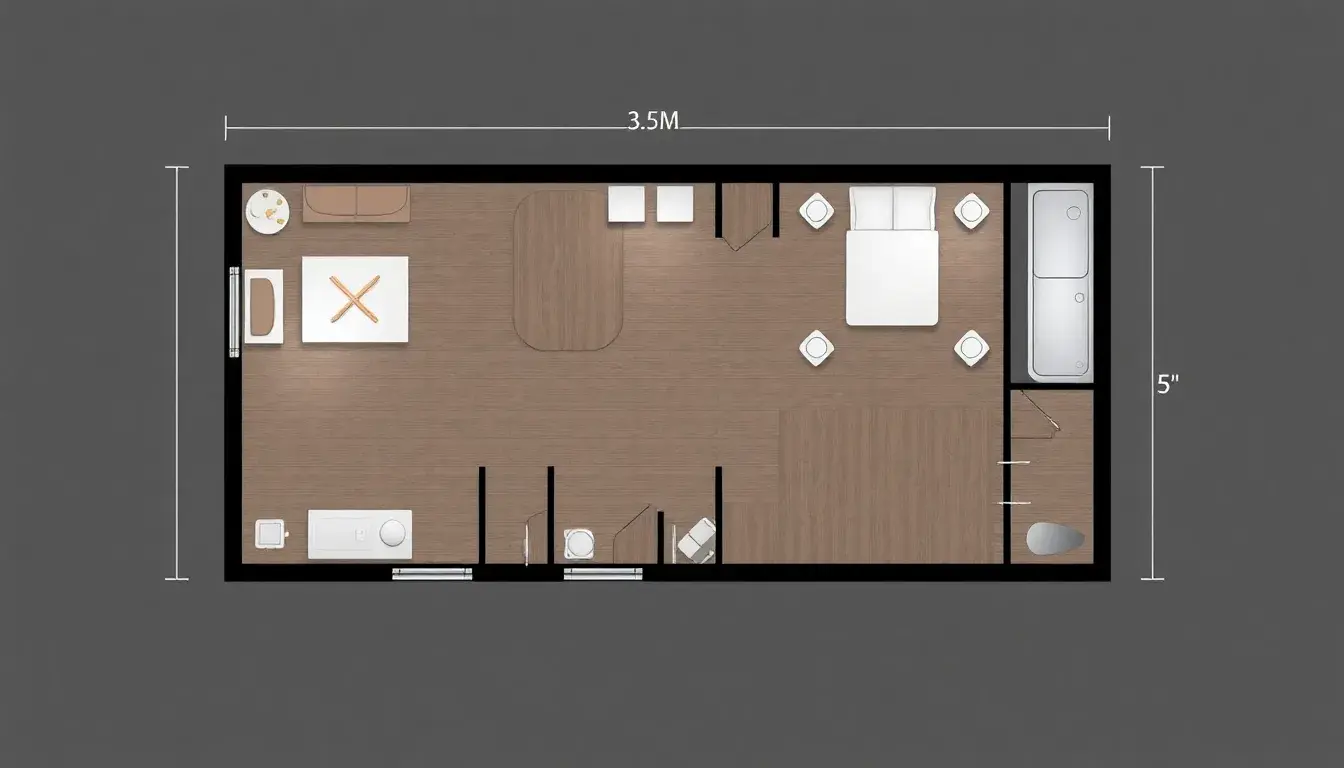
Ever found yourself standing in the middle of a room, staring at a blank floor or a stack of wallpaper rolls, and wondering if you actually bought enough? We've all been there. Whether you're planning a weekend DIY project, ordering new hardwood, or just trying to figure out if that massive sectional sofa will fit, knowing how to calculate square feet of a room is a life skill that saves you time, money, and a whole lot of headache.
In this guide, I’m going to break down the mystery of floor area math. We’ll move past the "guessing game" and get into the nitty-gritty of measuring, multiplying, and even handling those weird L-shaped nooks that drive everyone crazy. Best of all? I’ve brought along a clean, fast tool from Calczen.com to do the heavy lifting for you.
Before we dive into the "how," let's talk about the "why." If you’re hiring a contractor, they’re going to quote you based on square footage. If you're buying tiles at a big-box store, the boxes are labeled by—you guessed it—square feet. Even your home's heating and cooling requirements are determined by the volume and area of your rooms.
Knowing how to calculate square feet of a room accurately prevents "the return trip." You know the one—where you're one box of flooring short and the store just sold out of your specific dye lot. (Trust me, I’ve been there, and it’s not fun.)
For a basic rectangular or square room, the process is incredibly straightforward. It's the classic "Length times Width" formula we learned in grade school, put to real-world use.
You can’t get a straight measurement if you’re trying to bend a metal tape measure around a bed or a pile of laundry. Clear a path along two adjacent walls so you can get the tape flush against the baseboards.
Stretch your tape measure from one corner to the other along the longest wall. If you’re working alone, a laser measure is a game-changer—it’s like a little lightsaber for DIYers that gives you a digital reading instantly. Write down the number in feet. If you have inches (like 12 feet 6 inches), convert them to decimals (12.5 feet).
Now, do the same for the shorter wall. Make sure you are measuring from the wall surface, not the trim or molding, if you are calculating for flooring. If you are calculating for paint, include the trim!
This is where the magic happens. Multiply your Length by your Width. If your room is 12 feet by 15 feet, you’ve got 180 square feet. Simple, right?
Not every room is a perfect box. Some of us live in homes with "character"—which is just a nice way of saying "L-shaped living rooms and weird closets."
When a room isn't a rectangle, visualize it as a collection of smaller rectangles. Draw a quick sketch on a notepad. Split that L-shaped room into two distinct blocks. Calculate the square footage of "Block A" and "Block B" separately, then add them together. It’s much more accurate than trying to guess the average width.
Why crunch numbers manually when you can get instant accuracy? Explore our full suite of Construction & DIY Estimators and handle your next project with total confidence.
Explore Construction CalculatorsFor more technical definitions on area measurement, you can always check out the deep-dive on area calculation methods.
Learning how to calculate square feet of a room is one of those small skills that pays massive dividends. It turns an intimidating renovation project into a series of manageable numbers. No more overpaying for carpet, no more under-ordering paint, and no more "guesstimating" your way through a budget.
Next time you're at the hardware store and find yourself wondering if that "Value Pack" of laminate is enough for the den, just pull up Calczen.com on your phone. We're here to make the math easy so you can get back to the fun part of making your home yours.
No comments yet. Start the conversation!




Get weekly updates on new financial regulations, mathematical formulas, and CalcZen tools.
Join 25,000+ data-driven professionals. No spam, ever.