New Feature: Calculator results are now clearer and easier to use ⚡

Linear Interpolation Calculator

54 Uses
5 min read
Verified Accuracy

Disclaimer: The results provided by this calculator are for informational and educational purposes only and should not be considered professional advice. Accuracy is not guaranteed, and you should consult a qualified professional for decisions related to finance, health, legal matters, or medical treatment. By using this tool, you acknowledge that CalcZen.com is not responsible for any actions taken based on its results.

calczen-widget
⚡ Powered by CalcZen • Secure & Private • Real-time Results

How to Use a Linear Interpolation Calculator to Solve Life’s "In-Between" Problems

C

CalcZen.com

Updated: May 31, 2026

interpolation calculator

We’ve all been there. You’re working on a physics assignment, a chemistry lab, or maybe you're just trying to figure out the exact interest rate for a loan that falls between two standard terms. You have your "knowns"—those clear data points on a graph—but your specific scenario falls right in the crack.

Ever stared at a data table and realized the exact number you need is missing? You have the value for 10 and the value for 20, but you’re stuck needing the value for 15.7. It’s like being halfway between two exits on a highway without a map. That’s exactly where a interpolation calculator saves the day. Today, we’re diving into why this simple math concept is actually a productivity superpower.

The Magic of Finding the Middle Ground

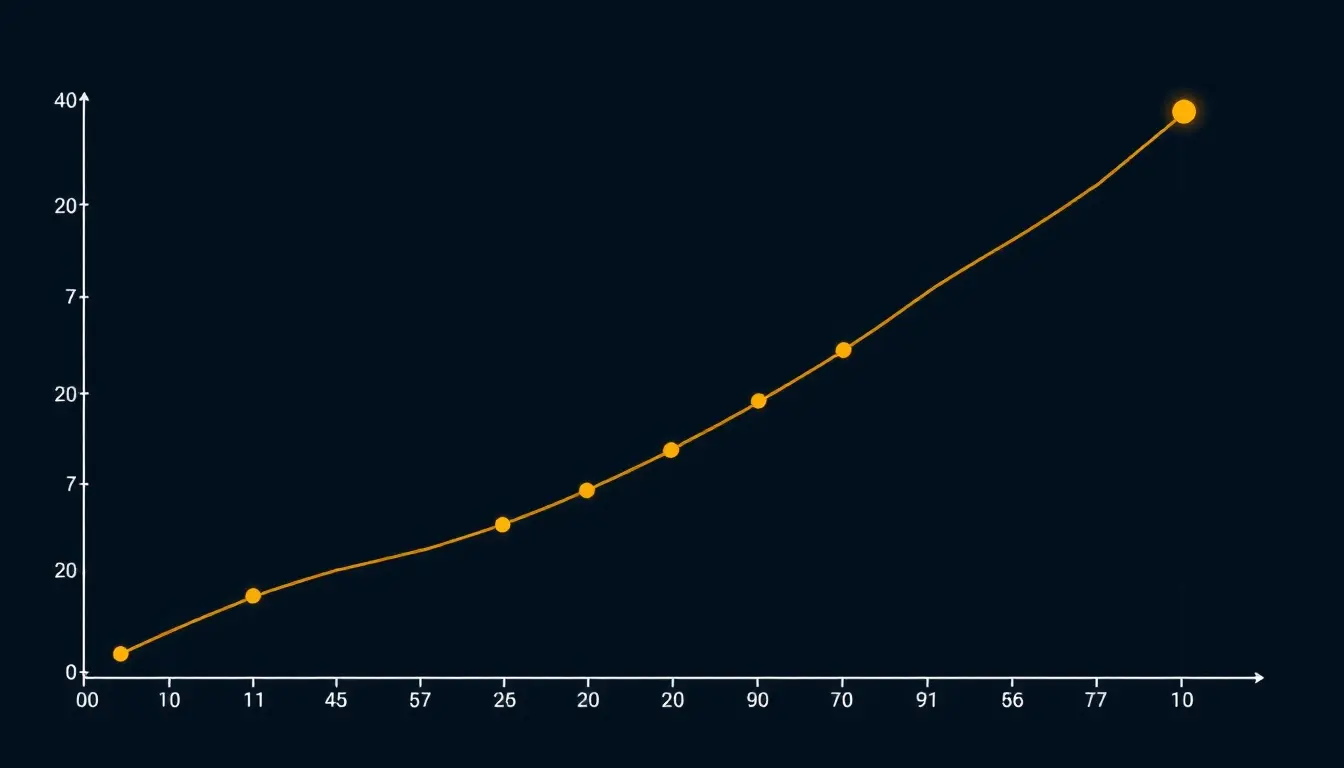
In the world of math, this is called "data estimation." Specifically, when we assume the change between two points is a straight line, we use linear interpolation. It’s the most common way to fill in the blanks because it’s fast, logical, and—when you use a solid Linear Interpolation Calculator—incredibly accurate.

Why it matters: Precision isn't just for mathematicians. Whether you're a student at 2 AM or a project manager trying to estimate growth, having a reliable way to calculate $y$ when you know $x$ (and the surrounding points) keeps your work professional and error-free.

How Does Linear Interpolation Actually Work?

Think of it like a staircase. If you know the height of the first step and the height of the third step, and you assume the stairs are even, you can easily guess the height of the second step. Mathematically, we are looking for a point on a line segment that connects two known coordinates: $(x_0, y_0)$ and $(x_1, y_1)$.

The core logic behind our interpolation calculator is the slope-intercept form. We find the slope of the line connecting your two points and then apply that same slope to find your missing value. If you want to get nerdy, here is what’s happening under the hood:

y = y0 + ((x - x0) (y1 - y0)) / (x1 - x0)

I know, I know—it looks a bit like alphabet soup. But that's the beauty of using a tool like the one on Calczen’s Math & Algebra section. You don't have to remember where the parentheses go; you just plug in your four knowns and your target $x$, and the answer pops out instantly.

Real-World Examples (Where This Actually Saves You Time)

I remember a time I was trying to figure out the thermal expansion of a metal rod for a DIY project. The reference book gave me figures for 20°C and 50°C. My garage was exactly 32°C. Instead of guessing (and potentially ruining the fit), I pulled up a Linear Interpolation Calculator, entered the data, and had my answer in three seconds. It’s these "micro-wins" that make digital tools so essential.

1. Science and Engineering Labs

Students often use steam tables or chemical concentration charts. Often, the measured temperature in your beaker isn't the nice, round number printed in the textbook. Interpolation allows you to find the exact pressure or density required for your lab report to be "A" grade material.

2. Financial Projections

Imagine you’re looking at a table for compound interest. The table shows 5 years and 10 years. What if your goal is 7.5 years? Linear interpolation gives you a much better estimate than just "splitting the difference" in your head, especially when large sums of money are involved.

3. Graphics and Game Design

In digital design, "Lerp" (Linear Interpolation) is used constantly to move a character from point A to point B smoothly over time. While the software usually handles the code, understanding the math helps you tweak the timing and movement to feel more natural.

Common Mistakes to Avoid

Even with the best interpolation calculator, "garbage in, garbage out" still applies. Here are a few things to keep in mind to ensure your numbers are actually useful:

  • Stay Within the Bounds: Interpolation is for finding values between points. If you try to find a value outside your $(x_0, y_0)$ and $(x_1, y_1)$, that's called extrapolation, and it’s much riskier because you're assuming the trend continues forever.
  • Check for Linearity: This method assumes a straight line. If you’re dealing with a curve (like exponential growth), linear interpolation will be slightly off. For most daily tasks, it's close enough, but for high-stakes engineering, keep that curve in mind!
  • Verify Your Units: Make sure all your $x$ values are in the same units (e.g., all Celsius or all Fahrenheit) before hitting calculate.

Crunch Numbers Faster on Calczen.com

Tired of clunky apps and sites buried in ads? We’ve built a suite of clean, fast, and 100% free tools to help you get through your to-do list with zero friction. Whether it's math, finance, or fitness, we've got you covered.

Explore All Calculators

Why Calczen is Your New Favorite Math Sidekick

I've spent years testing online tools. Most of them are... well, frustrating. They’re either covered in pop-up ads that move the "Calculate" button right as you're about to click it, or they haven't been updated since 2005. That’s why we created Calczen.com.

Our Linear Interpolation Calculator is designed for the modern user. It’s mobile-friendly, so you can use it in the lab or on the job site. It’s fast, because nobody has time to wait for a page to reload five times. And most importantly, it's built with accuracy at its core. If you need to dive deeper into the history of this math, you can always check out the Wikipedia overview on interpolation, but for the actual work? We’re here to help.

So, the next time you're stuck between two data points, don't sweat it. Head over to our site, plug in your $x_0, y_0, x_1, y_1$, and let us handle the heavy lifting. You've got more important things to do than manual algebra!

Share this Tool

Discussion (0)

Moderated
Security Check: 9 + 2 =

No comments yet. Start the conversation!

Related Tools & Calculators

Master Your Data.

Get weekly updates on new financial regulations, mathematical formulas, and CalcZen tools.

Join 25,000+ data-driven professionals. No spam, ever.

CALCZEN