New Feature: Calculator results are now clearer and easier to use ⚡

Topsoil Volume Calculator

85 Uses
7 min read
Verified Accuracy

Disclaimer: The results provided by this calculator are for informational and educational purposes only and should not be considered professional advice. Accuracy is not guaranteed, and you should consult a qualified professional for decisions related to finance, health, legal matters, or medical treatment. By using this tool, you acknowledge that CalcZen.com is not responsible for any actions taken based on its results.

calczen-widget
⚡ Powered by CalcZen • Secure & Private • Real-time Results

The Ultimate Topsoil Calculator Guide: How to Estimate Dirt Like a Pro (Naturally on Calczen.com)

C

CalcZen.com

Updated: Jun 03, 2026

topsoil calculator

Let’s be honest: nothing kills the excitement of a weekend landscaping project faster than running out of dirt halfway through, or worse, ending up with a mountain of leftover topsoil on your driveway that you now have to pay someone to haul away. I’ve been there—standing in the middle of a half-finished flower bed, sweating under the sun, wondering how my "best guess" was so wildly off. That’s exactly why I became obsessed with finding the perfect topsoil calculator approach. Whether you’re a seasoned DIYer or a first-time gardener, getting your volume right isn’t just about math; it’s about saving your back, your wallet, and your sanity.

Why Precision Matters in Construction & DIY Estimators

When we talk about Construction & DIY Estimators, we often think of complex blueprints and professional contractors. But the truth is, every backyard renovation is a small-scale construction project. Topsoil is the literal foundation of your garden's health. It provides the nutrients, moisture retention, and structural support your plants need to thrive. However, topsoil is also heavy, expensive to transport, and sold in units that don't always make sense to the average person—like cubic yards.

Most of us think in terms of bags from the local hardware store, but for any project larger than a single potted plant, you need to think in bulk. This is where a reliable topsoil calculator becomes your best friend. It bridges the gap between your garden's dimensions and the supplier's truckload. By accurately calculating your needs, you avoid the "double-delivery fee" trap and ensure your plants have the depth they need to survive the summer heat.

Pro Tip: Most landscaping supply companies have a minimum delivery requirement, often 1 to 3 cubic yards. If your calculation shows you need 0.8 yards, it might be cheaper to buy bags, but if you need 1.2 yards, ordering a bulk delivery is almost always the smarter financial move. Check out our Construction & DIY Estimators for more insights.

The Science of Soil: What is Topsoil, Anyway?

Before we dive into the numbers, we have to understand what we're actually measuring. Topsoil isn't just "dirt." It is the uppermost layer of the Earth's crust, usually the top 2 to 8 inches. It has the highest concentration of organic matter and microorganisms. According to Wikipedia's research on soil layers, this organic-rich horizon is vital for biological activity.

The Different Types of Soil You Might Encounter

When you call a local supplier, they might ask if you want "screened" or "unscreened" topsoil. Screened soil has been run through a mesh to remove large rocks, sticks, and debris. It’s much easier to work with but costs a bit more. Unscreened soil is great for filling deep holes or grading a yard where the finish doesn't need to be perfect. For gardens and lawns, always go for the screened variety—your shovel will thank you later.

You might also hear about "garden mix" or "3-way mix." This is usually a blend of topsoil, compost, and sand. It’s premium stuff. While a topsoil calculator works for all of these, remember that different mixes have different weights. Standard topsoil weighs about 2,000 to 2,200 pounds per cubic yard. If it's wet? It can easily hit 3,000 pounds. Keep that in mind if you're planning to pick it up in your own truck!

How to Use a Topsoil Calculator Like a Master

The math behind soil volume is actually quite simple once you break it down into steps. The goal of any topsoil calculator is to determine volume: Area multiplied by Depth. Here is the step-by-step process I use every single time I start a project.

Step 1: Measure Your Area

For rectangular or square beds, this is easy: Length × Width. If you have a circular garden, it's $\pi \times r^2$. (Don't panic! Just measure from the center to the edge, square that number, and multiply by 3.14). If your garden is a weird "kidney bean" shape, try to break it into several smaller rectangles and add them together. It’s better to be slightly over than under.

Step 2: Determine Your Depth

This is where most people guess and get it wrong. Different projects require different depths:

  • Lawn Top Dressing: 0.25 to 0.5 inches. Just enough to level the ground and give new seeds a home.
  • New Lawn Base: 4 to 6 inches. Grass roots need room to breathe and reach water.
  • Vegetable Gardens: 8 to 12 inches. Most veggies are "heavy feeders" and need deep, rich soil.
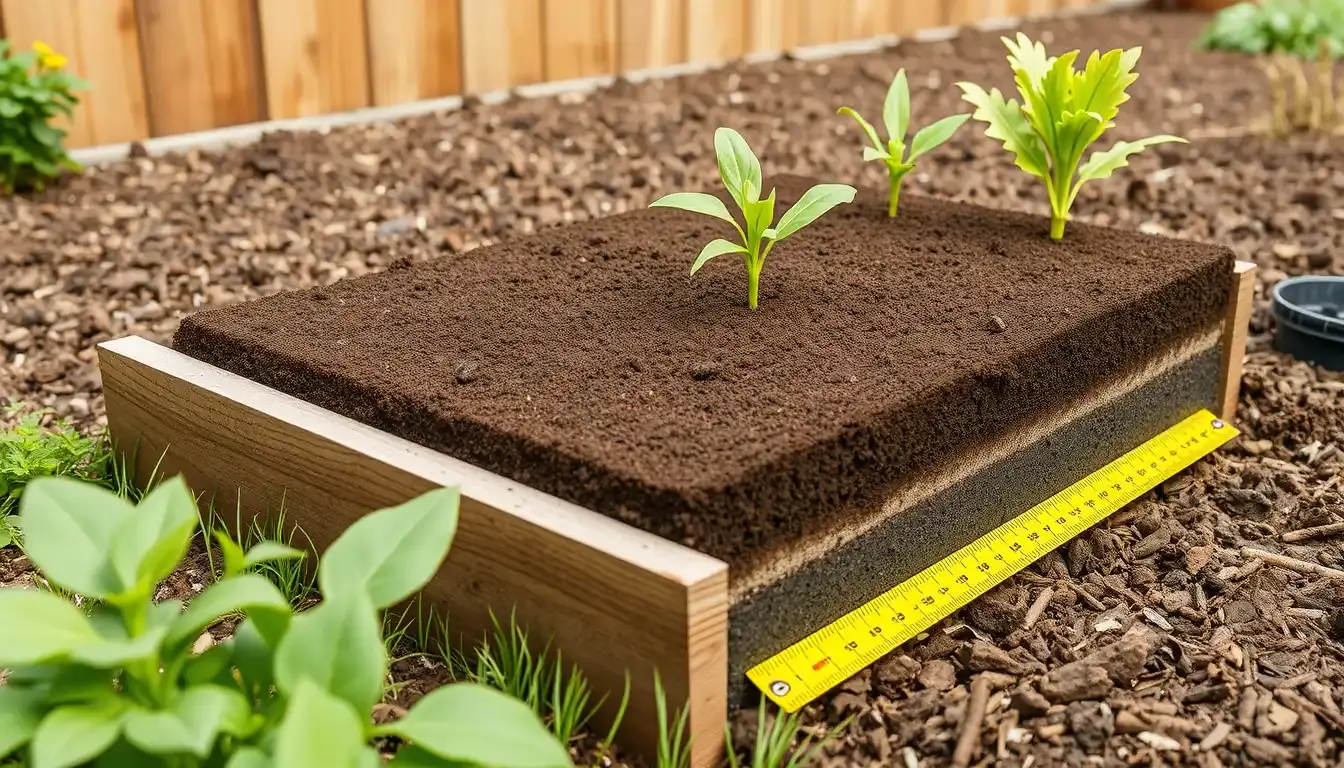
  • Raised Beds: Usually 12+ inches, depending on what you're planting.

Step 3: The Big Conversion

Since your area is likely in feet and your depth is in inches, you have to convert everything to the same unit (usually feet) and then divide the final cubic feet by 27 to get cubic yards. Why 27? Because there are 27 cubic feet in one cubic yard ($3 \times 3 \times 3$).

If you use a tool like the Topsoil Volume Calculator on Calczen.com, we do all that messy division for you. You just plug in the feet and inches, and—boom—you have your yardage.

Real-World Scenarios: Learning from My Mistakes

I remember my first "big" project. I wanted to put in a 10x20 foot vegetable garden. I figured, "Eh, six inches deep should be fine." I didn't use a topsoil calculator; I just eyeball-ordered two yards of soil. The truck arrived, dumped the pile, and I started shoveling. By the time I finished, I barely had three inches of coverage. I had to pay for a second delivery, doubling my transport costs. If I had just spent two minutes on Calczen.com, I would have known I needed exactly 3.7 cubic yards.

Accounting for Compaction

Here is a secret the pros won't always tell you: soil settles. When the soil is dumped in your yard, it’s "fluffy." Once you spread it, walk on it, and water it, it will compact. I always recommend adding a 15-20% "fluff factor" to your order. If the topsoil calculator says you need 5 yards, order 6. It’s much better to have a little extra for your potted plants than to have a sunken garden bed after the first rain.

The Cost of Convenience

Is it better to buy bags or bulk? Let’s do the math. A standard bag of topsoil is usually 0.75 or 1 cubic foot. Since there are 27 cubic feet in a yard, you would need 27 to 36 bags to equal one cubic yard. At $4 a bag, that’s $108 to $144 per yard. Bulk topsoil usually costs between $20 and $50 per yard. Even with a $60 delivery fee, bulk is cheaper for anything over 1.5 yards. Use a topsoil calculator to see where your "break-even" point is!

Ready to Calculate Smarter?

Don't let the "dirt math" ruin your weekend. Head over to Calczen.com and use our fast, ad-light Topsoil Volume Calculator to get your project started right.

Explore More Construction Estimators

Conclusion: Handle Your Numbers with Confidence

At the end of the day, landscaping is about creating a space you love. Whether it’s a lush green lawn for the kids to play on or a vibrant vegetable garden that feeds your family, it all starts with the right amount of soil. By using a topsoil calculator, you’re taking the guesswork out of the process. You’ll save time, money, and a lot of physical effort.

I’ve spent years testing different methods, and nothing beats the ease of a clean, no-nonsense online tool. Next time you're standing in your yard with a tape measure, remember: measure twice, calculate once, and always add a little for settling. You’ve got this!

For more reliable advice and simple tools that help you crunch numbers for loans, home improvement, or health, make Calczen.com your go-to resource. We’re here to help you calculate smarter and live better. Happy gardening!

Share this Tool

Discussion (0)

Moderated
Security Check: 5 + 5 =

No comments yet. Start the conversation!

Related Tools & Calculators

Master Your Data.

Get weekly updates on new financial regulations, mathematical formulas, and CalcZen tools.

Join 25,000+ data-driven professionals. No spam, ever.

CALCZEN